
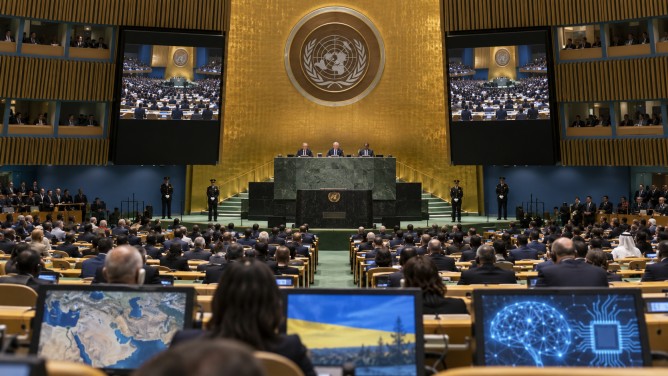
World leaders have convened in New York for the 81st United Nations General Assembly, where pressing global issues such as the conflicts in the Middle East and Ukraine, the rapid advancement of artificial intelligence, and the future of international cooperation are at the forefront of discussions. The high-level general debate is scheduled from September 22 to 26 and on September 28, with US President Donald Trump among those set to address the assembly.
Amid ongoing international tensions, Ukrainian President Volodymyr Zelenskyy is planning a meeting with President Trump during the UN session. The Middle East remains a critical focus, particularly the conflict involving Iran, which continues to impact regional security and energy supplies. Iranian President Masoud Pezeshkian and Israeli Prime Minister Benjamin Netanyahu are both expected to participate in the discussions.
The war in Ukraine is anticipated to be a prominent topic, with dialogue centered on its humanitarian impact and broader implications for food and energy security. Russia’s role as a permanent member of the UN Security Council continues to present challenges to the body’s ability to address the situation effectively.
Artificial intelligence is also a significant issue at this year’s assembly. UN Secretary-General António Guterres has called for increased international cooperation and the establishment of common safeguards as AI technology evolves. The UN has previously set up an advisory body to focus on AI governance.
Financial strains on the United Nations have brought additional scrutiny to its operations, with the United States recently contributing $725 million to fulfill its obligations and maintain its voting rights in the General Assembly. The US continues to advocate for reforms and spending cuts within the organization. As Guterres is set to leave his post at the end of 2026, discussions on leadership transition are also expected during the assembly.